
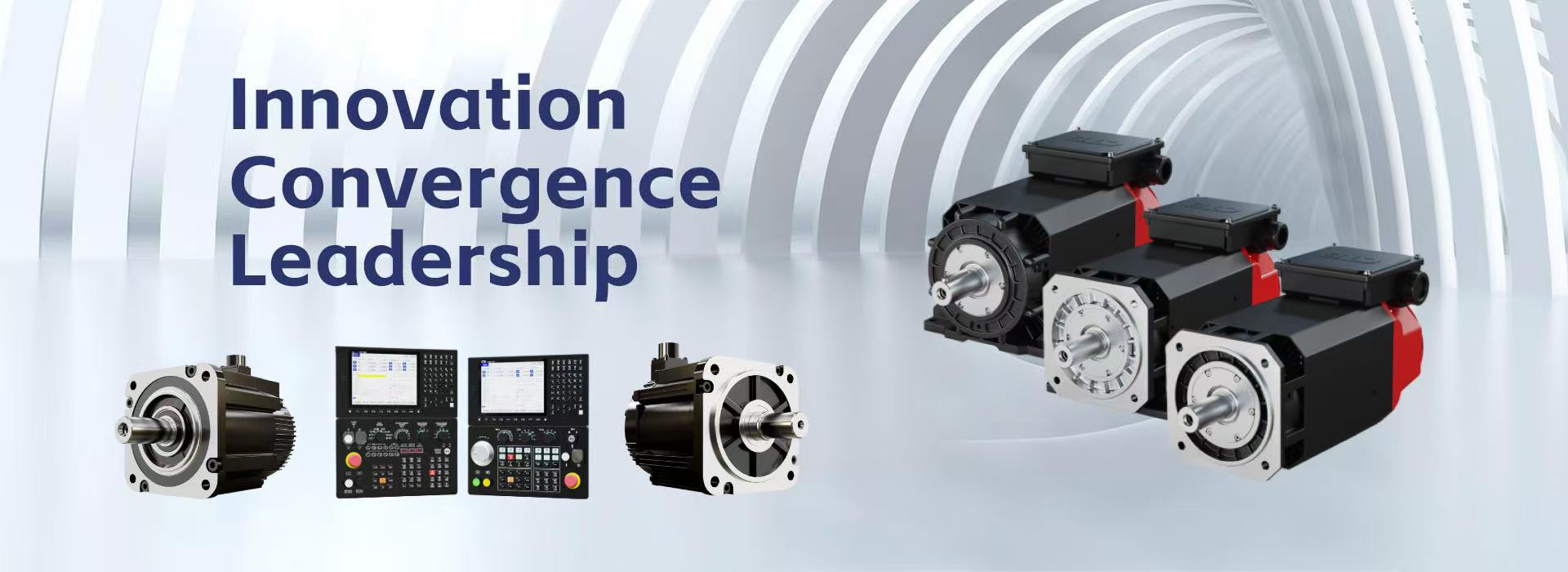
The fundamental distinction between servo spindles and variable-frequency spindles lies in their control logic: variable-frequency spindles primarily address speed regulation to deliver stepless speed variation, while servo spindles enable precise control of both speed and position, featuring superior dynamic response and positioning accuracy.
A detailed breakdown across four dimensions—control principles, low-speed performance, core functions, as well as cost and application scenarios—is provided below:
1. Control Principles and Hardware
Their essential differences stem from distinct drive hardware and control schemes.
Variable-Frequency Spindle (Analog Spindle)
Hardware: Frequency converter + standard three-phase asynchronous motor
Control mode: Open-loop or basic closed-loop control (V/F control or vector control). The CNC system transmits analog voltage signals (0~10V, for example) to the frequency converter to adjust rotational speed, yet the real-time rotor position cannot be accurately detected.
Servo Spindle (Digital Spindle)
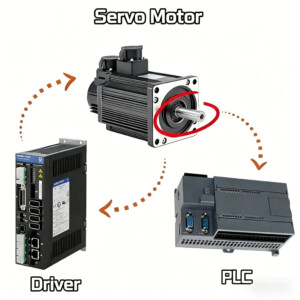
Hardware: Servo drive + servo motor (equipped with a built-in high-precision encoder)
Control mode: Full closed-loop vector control. The drive communicates with the CNC system via high-speed digital serial signals. The motor’s integrated encoder feeds back real-time position and speed data, forming a high-precision closed control loop.
2.Comparison of Key Machining Performance Between Variable-Frequency Spindles and Servo Spindles
The performance gap between the two types in practical machining mainly manifests in two core indicators: low-speed torque output and dynamic response speed. A detailed comparison covering low-speed performance, dynamic response, spindle positioning and orientation stop is presented as follows:
Low-Speed Performance
Variable-frequency spindles deliver poor low-speed performance. Their output torque drops significantly at low frequencies, making them incapable of heavy-load cutting. If high torque at low rotational speeds is required for machining, an additional reduction gearbox must be installed with mechanical gear shifting to compensate for insufficient torque.
Servo spindles feature excellent low-speed performance with inherent high low-speed torque characteristics. They can continuously output rated torque stably even at an ultra-low rotational speed of 1 r/min. Constant-power cutting can be realized throughout the entire speed range without any mechanical gear shifting mechanisms.
Dynamic Response
Variable-frequency spindles exhibit mediocre dynamic response. Their motors require longer acceleration and deceleration times, resulting in slow and sluggish spindle startup and stopping actions.
Servo spindles boast outstanding dynamic response with extremely short acceleration and deceleration cycles. Their velocity loop response reaches the microsecond level of 250 μs. The spindle starts and stops instantaneously, drastically cutting auxiliary machining time and improving overall machine processing efficiency.
Spindle Positioning and Orientation Stop
Variable-frequency spindles have no or extremely low precision positioning capability. Standard variable-frequency systems cannot achieve accurate position control. To realize spindle orientation stop for automatic tool change and rigid tapping processes, extra encoders must be fitted together with customized PLC logic programs. Even after such modifications, positioning accuracy remains limited, bringing risks of tool collision during machining.
High-precision positioning and orientation stop come as standard built-in functions for servo spindles, with dedicated internal control logic for orientation stop. Relying on the closed position loop control inside the servo drive, the spindle can perform high-accuracy fixed-point positioning, ensuring stable and reliable operation of automatic tool change and rigid tapping procedures.
Low-Speed Performance
Variable-frequency spindles deliver poor low-speed performance. Their output torque drops significantly at low frequencies, making them incapable of heavy-load cutting. If high torque at low rotational speeds is required for machining, an additional reduction gearbox must be installed with mechanical gear shifting to compensate for insufficient torque.
Servo spindles feature excellent low-speed performance with inherent high low-speed torque characteristics. They can continuously output rated torque stably even at an ultra-low rotational speed of 1 r/min. Constant-power cutting can be realized throughout the entire speed range without any mechanical gear shifting mechanisms.
Dynamic Response
Variable-frequency spindles exhibit mediocre dynamic response. Their motors require longer acceleration and deceleration times, resulting in slow and sluggish spindle startup and stopping actions.
Servo spindles boast outstanding dynamic response with extremely short acceleration and deceleration cycles. Their velocity loop response reaches the microsecond level of 250 μs. The spindle starts and stops instantaneously, drastically cutting auxiliary machining time and improving overall machine processing efficiency.
Spindle Positioning and Orientation Stop
Variable-frequency spindles have no or extremely low precision positioning capability. Standard variable-frequency systems cannot achieve accurate position control. To realize spindle orientation stop for automatic tool change and rigid tapping processes, extra encoders must be fitted together with customized PLC logic programs. Even after such modifications, positioning accuracy remains limited, bringing risks of tool collision during machining.
High-precision positioning and orientation stop come as standard built-in functions for servo spindles, with dedicated internal control logic for orientation stop. Relying on the closed position loop control inside the servo drive, the spindle can perform high-accuracy fixed-point positioning, ensuring stable and reliable operation of automatic tool change and rigid tapping procedures.
3. Practical Applications and Costs
Variable-Frequency Spindle
It boasts low costs and a simple structure, meeting the basic speed adjustment demands of most standard lathes and milling machines. However, lacking positioning capability, it fails to satisfy complex machining centers requiring rigid tapping and automatic tool change.
Servo Spindle
It delivers premium performance at a higher price, and is suitable for multi-functional machining centers, high-precision turning centers, engraving and milling machines, and other equipment. It stands as the optimal solution for precision machining processes such as reaming, boring, and thread cutting.
Summary
Variable-frequency spindles serve as a cost-effective option for equipment dedicated to rough machining with low positioning accuracy requirements and limited budgets.
Servo spindles deliver superior machining efficiency and precision for complex machining processes that demand rigid tapping, high-accuracy positioning, and fast acceleration/deceleration.
Variable-Frequency Spindle
It boasts low costs and a simple structure, meeting the basic speed adjustment demands of most standard lathes and milling machines. However, lacking positioning capability, it fails to satisfy complex machining centers requiring rigid tapping and automatic tool change.
Servo Spindle
It delivers premium performance at a higher price, and is suitable for multi-functional machining centers, high-precision turning centers, engraving and milling machines, and other equipment. It stands as the optimal solution for precision machining processes such as reaming, boring, and thread cutting.
Summary
Variable-frequency spindles serve as a cost-effective option for equipment dedicated to rough machining with low positioning accuracy requirements and limited budgets.
Servo spindles deliver superior machining efficiency and precision for complex machining processes that demand rigid tapping, high-accuracy positioning, and fast acceleration/deceleration.