
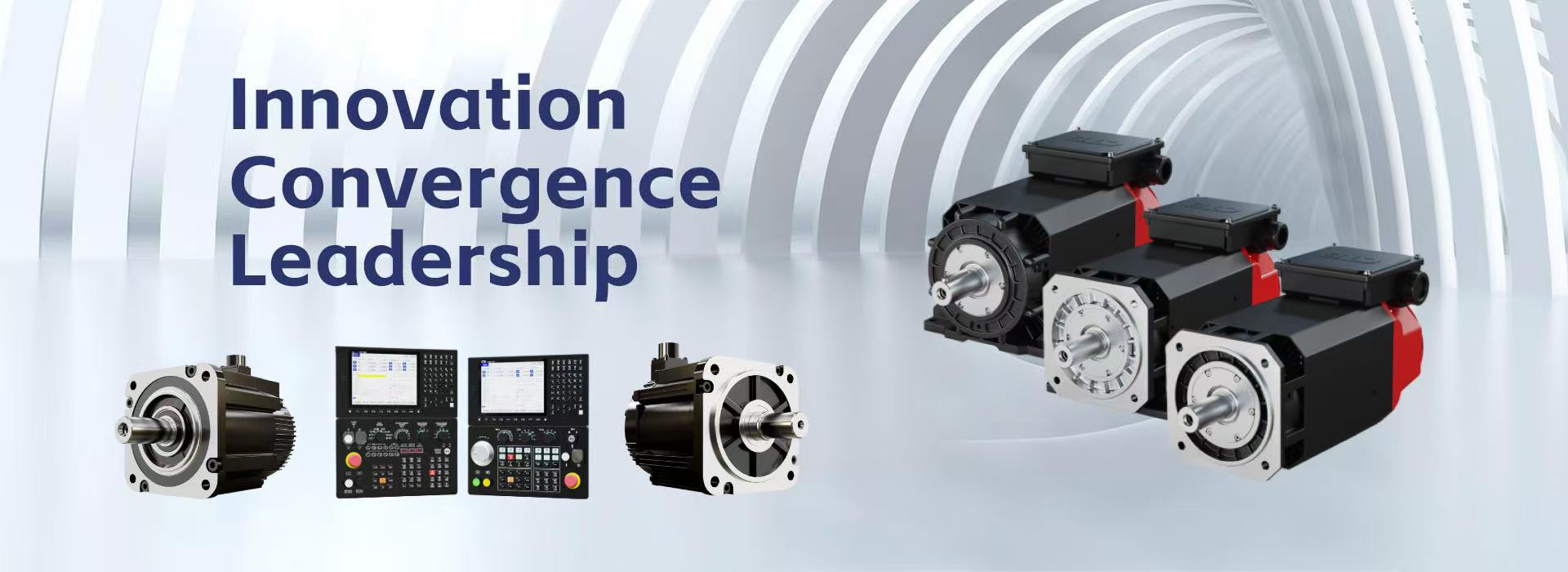
As a core drive component in modern industrial automation, servo motors are widely used in robots, CNC machine tools, medical devices, new energy equipment and other fields due to their high precision, fast response and stable control. This article systematically introduces the definition and industrial application scenarios of servo motors, and deeply analyzes their core classification dimensions, helping readers gain a comprehensive understanding of the latest technologies and development trends of this key component.
Source: Baidu Images
Definition and Core Value of Servo Motors
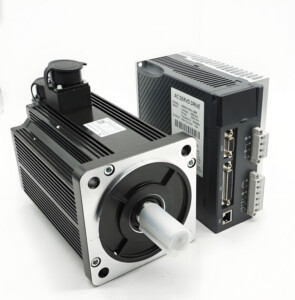
A servo motor is a motor system that achieves precise position, speed or torque output through closed-loop feedback control. Its core structure consists of the motor body, high-precision encoder and drive controller. By monitoring the output status in real time and adjusting the input signal, it ensures accurate motion control.
In recent years, the energy efficiency and intelligence of servo motors have improved significantly. The IE5 energy efficiency standard issued by the International Electrotechnical Commission (IEC) has promoted the popularization of a new generation of high-efficiency servo motors, with the comprehensive efficiency of some advanced products exceeding 94%. Meanwhile, leading manufacturers such as Yaskawa and Inovance have launched “intelligent servo systems” integrating drives, motors and AI algorithms.
Industrial Application Scenarios of Servo Motors
The application scenarios of servo motors highly depend on their technical characteristics, and performance requirements vary significantly across industries.
In the field of industrial robots, collaborative robots require servo motors with high dynamic response (acceleration up to 50 rad/s²) and extremely high repeat positioning accuracy (±0.02mm) to ensure the stability of flexible production.
The medical device industry imposes stricter requirements on servo motors. Surgical robots (such as the Da Vinci system) must meet low noise (<50dB), dust-free design and electromagnetic compatibility (EMC) requirements to avoid interference with precision instruments.
The new energy industry focuses more on corrosion resistance and power density. For example, photovoltaic panel welding equipment typically uses servo motors with IP65 protection to adapt to high-dust outdoor environments.
According to the 2024 China Servo System Market Report by MIR DATABANK, industrial robots accounted for as high as 32.5% of the global servo motor market in 2023, making it the largest application area, followed by CNC machine tools (21.8%) and electronic manufacturing equipment (18.3%).
Core Classification Dimensions of Servo Motors
1. Classification by Motor Type
The basic classification of servo motors is based on motor topology, mainly including DC servo motors, AC servo motors and linear servo motors.
DC servo motors adopt a structure with carbon brushes and commutators, driven by DC power. Although low in cost, their market share has dropped to less than 5% due to maintenance issues caused by brush wear. Today they are only used for replacement in some legacy equipment.
AC servo motors dominate the current market and are further divided into Permanent Magnet Synchronous Motors (PMSM) and asynchronous servo motors.
PMSMs use rare-earth permanent magnets (such as neodymium iron boron), featuring high efficiency (>90%) and high power density, and are widely used in industrial robots and precision equipment. Tesla adopts a customized PMSM solution for the joint drives of its humanoid robot Optimus, boosting torque density by 20% through optimized magnetic circuit design (Tesla AI Day 2024).
Asynchronous servo motors, with no permanent magnets, are more suitable for high-power applications such as mining machinery and wind power pitch systems, though their dynamic performance is slightly inferior to PMSMs.
Linear servo motors are a special category that achieves linear motion by directly driving the load, eliminating transmission mechanisms such as ball screws and belts. They are especially suitable for ultra-high-precision scenarios. For example, ASML lithography machines use linear motors to achieve nanometer-level positioning of wafer stages, with repeat accuracy up to ±0.01μm.
Source: Baidu Images
2. Classification by Encoder Type
The encoder is the core component for closed-loop control in servo motors, and its type directly affects system accuracy and reliability.
Optical encoders are the first choice for high-end applications, with resolution up to 23 bits (8.38 million pulses per revolution) and strong anti-interference capability, though at a higher cost. They are mostly used in semiconductor equipment and precision machine tools.
Magnetic encoders dominate AGVs and logistics sorting equipment due to their oil resistance and vibration resistance, but their resolution is generally limited to 16 bits (65,000 pulses/rev).
Resolvers are suitable for extreme environments (e.g., temperature range from -40℃ to 120℃) and commonly found in aerospace and military applications.
Encoder technology has continued to advance in recent years. In 2024, HEIDENHAIN launched a new optical encoder with 27-bit resolution, meeting the stringent positioning accuracy requirements of next-generation EUV lithography machines. In addition, signal processing algorithms for magnetic encoders have improved significantly, with some manufacturers raising their actual accuracy to nearly 18-bit levels through AI compensation technology.
3. Classification by Power Rating
Power rating directly determines the applicable scenarios of servo motors.
Small servo motors (<1kW) account for 45% of sales in the Chinese market, mainly used in electronic manufacturing equipment such as chip mounters and winding machines, where high response speed and compact structure are key requirements.
Medium servo motors (1–10kW) are the mainstay of industrial automation, with particularly strong demand growth in lithium battery production equipment, at an annual growth rate of 18%.
Large servo motors (>10kW) are applied in heavy industries such as wind power pitch systems, where domestic production rate has exceeded 60%.
4. Classification by Communication Protocol
The communication protocol of servo motors determines the efficiency of interaction with upper-level control systems. Traditional pulse control is gradually being replaced by industrial Ethernet protocols.
EtherCAT holds a market share of over 50% thanks to its low latency (<1μs) and high synchronization, making it the preferred choice for robots and high-end equipment.
PROFINET enjoys advantages in automotive manufacturing due to deep compatibility with the Siemens PLC ecosystem.
Notably, Time-Sensitive Networking (TSN), an emerging protocol standard (IEEE 802.1Qbv-2024), is driving the construction of 5G-enabled factories to achieve microsecond-level synchronous control across devices.
5. Classification by Industry-Specific Design
Specific industries impose differentiated requirements on servo motors.
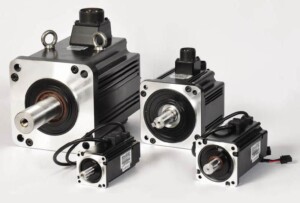
Explosion-proof servo motors must obtain ATEX/IECEx certification and adopt fully enclosed cast aluminum housings, suitable for hazardous environments such as petrochemical plants.
Food-grade motors require stainless steel housings and IP69K protection to withstand high-pressure washing and acid-alkali corrosion.
In high-cleanliness fields such as semiconductor fabs, servo motors use non-magnetic materials and control volatile emissions. Mitsubishi Electric’s HG-KN series is optimized specifically for such scenarios.
Future Trends and Selection Recommendations
Servo motor technology is evolving toward integration, intelligence and greenization. The application of silicon carbide (SiC) power devices has further improved drive energy efficiency.
For selection, it is recommended to prioritize matching load characteristics while paying attention to industry protocol standards. In the future, with the deep application of AI algorithms in motion control, the adaptive capability of servo systems will achieve a qualitative leap.